

Tying the Intruder: The Fly That Changed Steelhead Fishing Forever
Ed Ward built a fly so big it needed its own casting system. The Intruder separated the hook from the materials, solved the leverage problem, and launched a design revolution that redefined how we chase steelhead. Here's how to tie one.

Tying the Intruder: The Fly That Changed Steelhead Fishing Forever
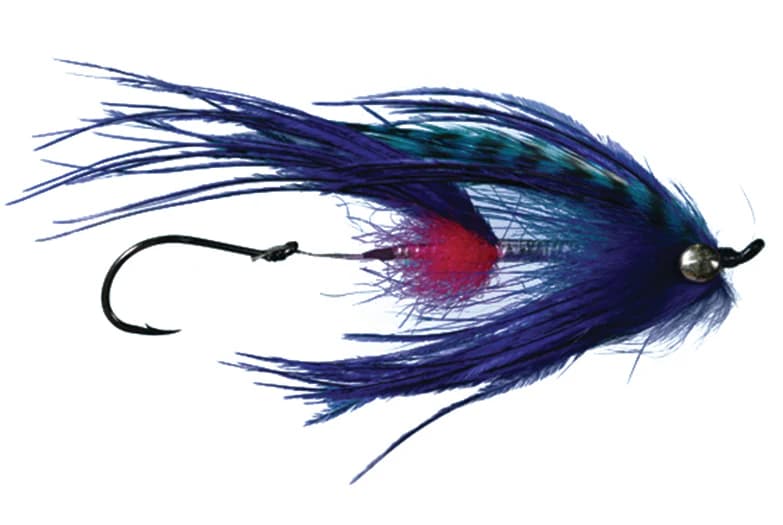
The Intruder is not a fly in the traditional sense. It's a 3-to-4-inch mass of ostrich herl, rubber legs, flash, and fur tied on a hookless metal shank with a small trailing hook dangling behind it on a wire tether. It looks like something that escaped from a craft store. It casts like a wet sock. And it is, by nearly universal agreement, the most important breakthrough in steelhead fly design in the last fifty years.
Before the Intruder, steelhead flies were variations on a theme — wet flies and streamers tied on long-shank hooks, fished on the swing. Some were elegant. Some were crude. All of them shared a fundamental problem: the bigger you tied the fly, the more leverage the fish had to throw the hook. A steelhead pinned on a 3/0 spey hook has a three-inch crowbar in its mouth. It's going to win that fight more often than not.
Ed Ward solved the problem by separating the fly from the hook entirely. And in doing so, he changed everything.
The Origin Story
The Intruder was born in Alaska in the early 1990s, not on a steelhead river. Ed Ward, along with Jerry French and Scott Howell, was guiding at a wilderness lodge and tying oversized flies on 3/0 spey hooks for king salmon. The flies worked — kings ate them — but two problems became impossible to ignore. First, the massive hook shank gave the fish enormous leverage, and landing rates were dismal. Second, almost every fish they brought to hand on those big hooks was bleeding badly. The mortality was unacceptable.
Ward's solution was deceptively simple: tie the fly materials on a hookless shank and trail a small octopus hook behind it on a piece of wire. The shank provided the tying platform for a huge, attention-grabbing profile. The trailing hook, freed from the weight and leverage of the materials, stuck cleanly in the corner of the jaw. Landing rates jumped to 85-90 percent. Bleeders virtually disappeared.
Ward noticed that enormous rainbow trout were hammering these king salmon flies with abandon. The connection to steelhead — the rainbow's anadromous cousin — was immediate. The following season on his home water, Washington's Skagit River, Ward began experimenting with the design for steelhead. The results were immediate and devastating.
The fly needed a name. During a test session on the river, Jerry French watched Ward swimming one of his latest creations — "this crazy thing with tentacles going everywhere" — and announced: "Intruder alert. Intruder alert." Like Robby the Robot from Lost in Space. The name stuck, and it was perfect. This was never meant to imitate food. Ward designed it to trigger territorial aggression — something a steelhead would want to crush, annihilate, and get out of its space.
For years, the Intruder existed as something close to a myth — a pattern whispered about by a tight circle of anglers on the Skagit and Sauk Rivers, seen in vague photos in Trey Combs' books but never fully documented. Tyler Kushnir, a friend of Ward's, recalls the first time he met Ed on the banks of the Sauk: "Wow, you really do exist." Until Ward showed him an actual Intruder up close, Kushnir had been guessing at the pattern from a single blurry photograph.
Why the Shank Changes Everything
The genius of the Intruder isn't any single material. It's the architecture — the separation of the tying platform from the hook.
No leverage. When a steelhead eats an Intruder and the hook sets, the shank slides freely along the wire or braid connection. All that's left in the fish's mouth is a small octopus hook with no lever arm. Compare this to a traditional 3/0 streamer hook, where three inches of steel give the fish a wrecking bar to pry against. The landing rate difference is dramatic.
Massive profile, minimal weight. Shanks are light — far lighter than equivalent-length hooks. Combined with materials like ostrich herl that create huge volume without absorbing water (unlike rabbit strip or marabou, which get heavy when wet), the Intruder achieves a plug-like 3-4 inch profile that remains castable on a two-handed rod with a Skagit head.
Replaceable hooks. When a hook dulls or bends, you don't lose the fly. Clip the wire, thread on a new octopus hook, crimp, and keep fishing. A well-tied Intruder can outlast dozens of hooks.
Clean hookups. The trailing hook rides point-up behind the fly, away from the bottom. Snags decrease. Hook-sets improve. Fish are almost always hooked cleanly in the corner of the jaw, not deep in the throat.
Materials
The Standard Intruder (Winter Steelhead, ~3.5")
| Material | Specification |
|---|---|
| Shank | 40mm articulated (Senyo Steelhead Shank, Aqua Flies, or 45mm Waddington) |
| Thread | 6/0 UNI-Thread, black |
| Trailing Hook | Octopus style, size 2 (Owner or Gamakatsu) |
| Connection | Senyo Intruder Wire (.018" medium) or Beadalon .015 |
| Eyes | 3/16" brass or lead dumbbell eyes (optional) |
| Rear Station | Ostrich herl (4-6 plumes), flash, rubber legs |
| Front Station | Ostrich herl (4-6 plumes), arctic fox or temple dog collar |
| Body | Dubbing or chenille, holographic tinsel rib |
| Flash | Flashabou or Krystal Flash, 4-6 strands per side |
| Legs | Rubber legs, 6-8 strands total |
Material Notes
Ostrich herl is the heart of the Intruder. Ed Ward discovered that ostrich plumes were even longer than the turkey feathers he'd been using, and nothing else creates the same volume of movement with so little material. Wrap ostrich using a dubbing loop for maximum durability — bare stems break easily when wrapped directly.
Arctic fox serves as the supporting collar that keeps the ostrich from collapsing in current. Its stiff guard hairs hold the softer materials aloft while its white underfur glows in the water, reflecting ambient light.
Ring-necked pheasant tail is the overlooked ingredient in Ward's originals. He would soak the center tail fibers, split them with a razor blade, and wrap them while wet. The result was a relatively stiff hackle that retained bulk without absorbing water — a technique that speaks to the level of intentionality in Ward's material selection.
Tying the Intruder: Step by Step
Step 1: Attach the trailing hook. Cut 6 inches of Intruder wire. Fold in half, aligning the ends. Thread both ends back-to-front through the octopus hook eye. Work the loop down over the hook bend and cinch tight behind the eye. You now have two wire tails extending from the hook.
Step 2: Mount the shank and secure the wire. Place the shank in the vise. Lay the wire tails along the near side of the shank. Take a few light thread wraps to position them, then bind firmly along the top of the shank toward the rear. Leave roughly one hook-length of wire exposed between the tie-down point and the shank — this gap allows the hook to swing freely and can be adjusted for different trailing distances. Tuck the wire ends through the shank eye and bind to the underside. Coat the wire wraps with UV resin.
Step 3: Build the rear station. At the rear third of the shank, tie in 4-6 strands of flash extending backward. Add 6-8 strands of rubber legs, splayed evenly. Create a dubbing loop, insert 3-4 ostrich herl plumes (matched in length, tips aligned), and wind forward 3-4 turns. Stroke fibers backward after each wrap. Tie off. The rear station should be full but not dense — the idea is maximum movement from minimum material.
Step 4: Build the body. Dub or wrap chenille forward to the front third of the shank, leaving room for the front station. Add a rib of holographic tinsel if desired — it catches light and adds depth to the body.
Step 5: Build the front station. Repeat the ostrich herl dubbing loop process for the front collar. This station should be slightly larger than the rear — more plumes, more wraps. After the ostrich, add a collar of arctic fox or temple dog hair, tips extending backward to the rear station. The hair supports the ostrich and prevents it from collapsing in current.
Step 6: Add eyes and finish. If using dumbbell eyes, tie them on top of the shank behind the eye loop. Build a neat thread head, whip finish, and apply UV resin. The finished fly should be 3-4 inches long with a full, flowing silhouette that moves at rest.
Color Selection
The Intruder's color palette follows steelhead swing-fly logic — dark and natural for clear water, bright and contrasting for colored water, and black works everywhere.
Black/Blue — The classic. The top-tier winter steelhead Intruder. Black ostrich with blue flash and blue-dyed arctic fox. Reads dark and menacing underwater, with the blue providing just enough contrast to draw the eye in low light.
Black/Orange — The most versatile single color combination. Covers the widest range of water conditions. Black body with orange ostrich and orange rubber legs. Effective from clear to moderately stained.
Pink/Orange — The cold-water standard. When water temperatures drop below 45°F, brighter colors tend to move fish that ignore darker presentations. Pink and orange is the go-to in the dead of winter.
Purple/Black — High contrast that reads as dark underwater but holds better definition than true black at depth. Jerry French's Dirty Hoh — a hybrid between an Intruder and a String Leech using rabbit strip — is available in this combination.
Olive/Black — The subdued option for clear, low water. Smaller profile, natural tones. Works when bright flies put fish down.
How to Fish It
The Intruder was designed for one thing: the swung fly on a two-handed rod. It co-evolved with the Skagit casting system — the short, heavy shooting heads that Ward, French, and their circle developed specifically to throw these flies on Pacific Northwest steelhead rivers with tight backcast corridors.
The setup: A 12-14 foot spey rod, a Skagit shooting head (500-580 grain depending on the rod), a 6-12 foot T-14 sink tip, and a short leader of 3-4 feet of 12-16 pound fluorocarbon. The Skagit head is designed to turn over heavy flies and sink tips in a single cast — it's essentially a weight-forward fly line compressed into 20 feet.
The swing: Cast at a downstream angle — roughly 45 degrees across the current. Execute one deliberate upstream mend that moves the entire Skagit head, not just the running line. This positions the fly as the leading element of the swing. Let the current sweep the fly across the run on a tight line. When it hangs directly below you, let it dangle for 3-5 seconds (steelhead often follow and eat on the hang). Step 2-4 feet downstream and repeat.
Adjusting depth: In cold water below 42°F, cast at a steeper angle (more across-stream) for a slower swing that lets the fly sink deeper. In warmer water or shallower runs, use a shallower angle for a faster, higher presentation. Swap sink tip lengths to match — longer tips for deeper runs, shorter for skinny water.
Where it works: Classic steelhead runs with moderate depth and current — the kind of water that screams "a fish lives here." Tailouts, the heads of pools, current seams along structure. The Intruder is not a pocket-water fly — it needs room to swing and room for the materials to work.
Beyond the Pacific Northwest
The Intruder started on the Skagit, but it didn't stay there. The design has spread to every significant steelhead fishery in North America:
Great Lakes — Intruder-style patterns are now standard on Lake Erie, Lake Michigan, and Lake Superior tributaries. The "Superhero," a dedicated Great Lakes Intruder, was designed specifically for the tighter quarters and shorter runs of Midwest tributaries.
British Columbia — BC steelhead rivers like the Dean, Kispiox, and Skeena system have embraced Intruders. The fly suits the big water and aggressive fish.
California — Winter steelhead on the Smith, Eel, and Klamath respond to swung Intruders in the classic PNW style.
Trout spey — Micro Intruders tied on 20mm shanks with size 8-10 trailing hooks have opened the pattern to trout anglers. Tied in earth tones — olive, brown, black, cream — and fished on 2-4 weight trout spey rods, they're effective on rivers where big articulated streamers would be overkill. Fred Telleen's Montana Intruder is a notable trout-scale adaptation.
The Intruder's Legacy
What Ward, French, Howell, and their circle built on the Skagit wasn't just a fly pattern. It was an entire system — fly design, casting technique, and line development evolving together in real time through the 1990s and 2000s. French co-founded OPST (Olympic Peninsula Skagit Tactics) and later built Aqua Flies, commercializing the designs and materials that had been underground for years.
Today, "Intruder-style" describes an entire category of flies rather than a single recipe. The shank-and-trailing-hook architecture dominates big-fly steelhead and salmon tying worldwide. The Hoh Bo Spey, the Dirty Hoh, the Bunny Leech variants tied on shanks — all trace their lineage to Ward's original concept.
Video Tutorials
Tom Rosenbauer's Intruder: Orvis: Tying the Intruder Steelhead Fly — Rosenbauer walks through the pattern with his characteristic clarity. Good overview of the shank-and-trailing-hook system.
Davie McPhail's Intruder variation: Davie McPhail: Tying the Opossum Snake Intruder — McPhail's Scottish precision applied to the PNW classic. Beautiful material selection and wrapping technique.
Detailed 4K tutorial: How to Tie an Intruder — 4K Steelhead Fly Tying — Close-up detail on trailing hook wire attachment, dubbing loops, and material layering.
The Intruder is not the easiest fly to tie. The trailing hook connection takes practice. Material selection matters. The proportions need to be right — too sparse and it doesn't push enough water; too dense and it won't cast. But once you've tied a dozen, put them in the water, and watched the materials come alive in the current — ostrich pulsing, rubber legs twitching, the whole assembly breathing and flowing like something with its own nervous system — you understand why this fly changed everything. It wasn't designed to look like food. It was designed to make steelhead angry. And it does that better than anything before or since.
Frequently Asked Questions
Who invented the Intruder fly?
Ed Ward created the Intruder on the Skagit River in Washington during the late 1990s. He needed a fly large enough to provoke aggressive steelhead takes in cold, high water but light enough to cast on a Skagit head. The solution was an oversized, sparsely tied fly with a trailing hook — a design that changed steelhead fishing permanently.
What does the Intruder imitate?
Nothing specific — and that's the point. The Intruder is a provocation fly, not an imitation. Its size, movement, and profile trigger territorial aggression in steelhead rather than a feeding response. The materials push water and create a living, breathing silhouette that steelhead can't ignore.
What rod do I need to fish an Intruder?
A two-handed spey rod, typically 12-13 feet in 7-8 weight, with a Skagit head and sink tip. The Intruder was designed specifically for Skagit casting — the heavy, compact head loads the rod and turns over the large, air-resistant fly. Single-hand casting an Intruder is possible but impractical on most steelhead water.
Is the Intruder hard to tie?
It's an advanced pattern. The trailing hook connection with wire or Dacron requires practice to get secure. Material selection and proportion matter — ostrich herl, rubber legs, and flash must be sparse enough to cast but full enough to push water. Tie a dozen before you trust your construction on the river.
What colors work best for Intruder flies?
Black/blue is the all-around standard for winter steelhead. Pink/orange excels in clear, low water. Chartreuse/white is the dirty-water option. Purple is the dark horse that produces on overcast days. Most steelhead guides carry 3-4 color combinations and rotate based on water clarity and light.
 ™
™